Laser hair removal for Indian skin: what makes it safe.
Modern long-pulse lasers bypass the pigment in your skin and target the follicle instead. That single change is what made laser hair reduction genuinely safe for Indian skin.
Understanding your skin type
Indian skin tones typically fall between Type III and Type VI on the Fitzpatrick Scale, which means more melanin. In the early days of laser technology, lasers couldn't reliably distinguish between the melanin in the hair and the melanin in the surrounding skin, and that raised the risk of burns.
The breakthrough was modern long-pulse lasers, designed to bypass the pigment in your skin and focus their energy exclusively on the hair follicle.
Which laser is right for you
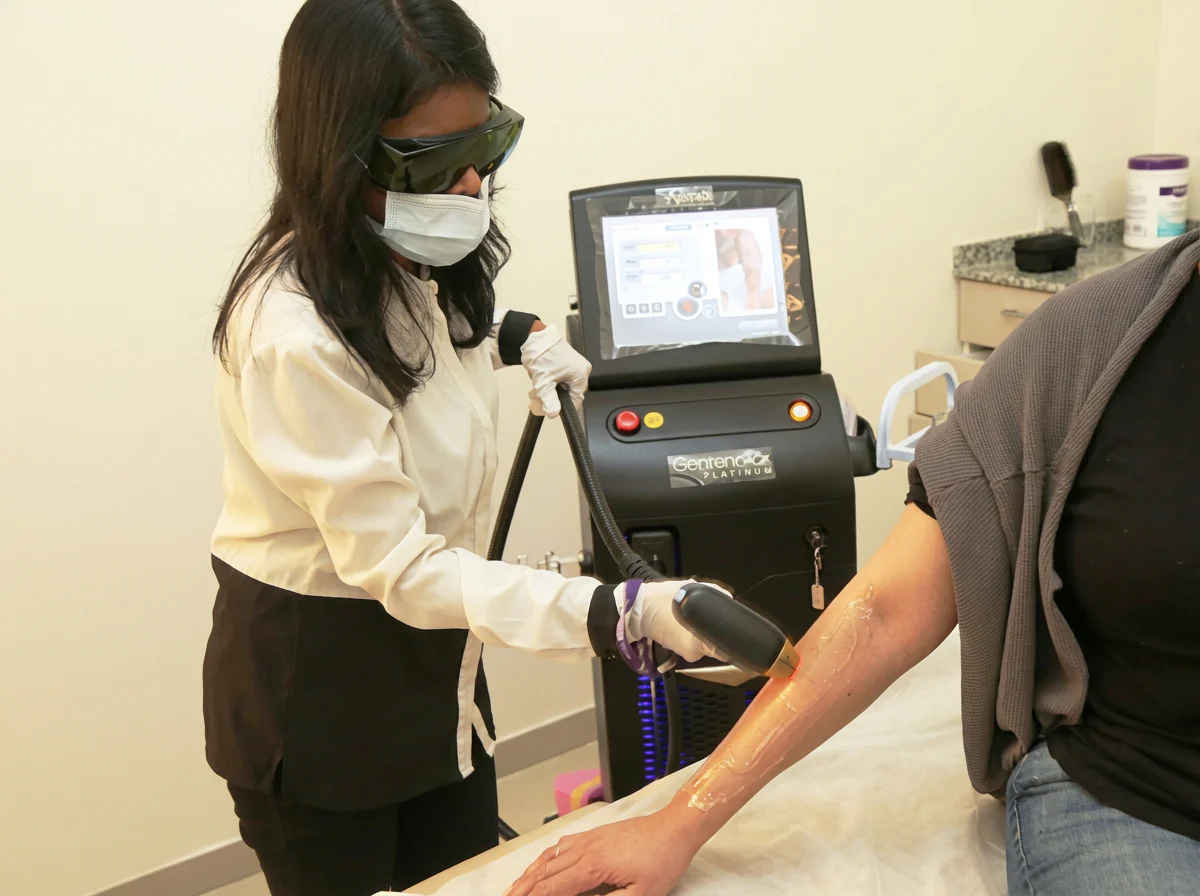
There is no one-size-fits-all laser. For laser hair reduction at Theory of Skin, Dr. Sanjana chooses the laser based on your specific skin tone and hair thickness.
- Nd:YAG (1064 nm): the safest and most effective laser for deeper Indian skin tones. Its long wavelength travels deep into the dermis, skipping surface pigment to destroy the hair root without heating the skin.
- Diode (810 nm): ideal for medium skin tones and coarse hair, with in-motion technology and sapphire cooling tips that keep the skin chilled through the session.
What treatment looks like, step by step
The consultation
Every plan starts with a patch test. Dr. Sanjana checks your skin type, hair density and medical history, because conditions like PCOS and hormonal imbalance change the plan. The settings are then set for you, not for an average patient.
How many sessions
Hair grows in three phases: anagen (active), catagen (transition) and telogen (resting). The laser only works on hair in the active phase, which is why you need six to eight sessions spaced four to six weeks apart to catch every hair in its growth cycle.
What it feels like
Forget the drama of waxing. Most patients describe it as a mild tingling, or the snap of a thin rubber band. With integrated cooling the procedure is very tolerable, even on sensitive areas like the bikini line or face.
Preparation and aftercare: the golden rules
- Before: shave the area 24 hours before your appointment. Do not wax or pluck, because the laser needs the root in place to target it. Avoid sun exposure for two weeks before.
- After: apply the prescribed soothing gel or moisturiser, use broad-spectrum SPF 50+ religiously on any treated area exposed to sun, and skip the gym, sauna and hot showers for 24 to 48 hours.
Cost versus value
Each session costs more than a salon waxing visit, but the sessions come to an end. Add up years of razors, wax strips, time spent and painful ingrown hairs, and laser hair reduction usually comes out ahead on cost and on comfort.
Common questions
It gives a large, long-term reduction rather than a promise of zero hair. What grows back after a full course is usually finer and lighter, and a touch-up session once or twice a year keeps it that way.
It feels like a warm snap against the skin. Diode lasers with built-in cooling, like the triple-wavelength platform at Theory of Skin, Indiranagar, are among the more comfortable options, and most people manage without numbing cream.
Yes, for the upper lip, chin, jawline and cheeks, with settings matched to your skin. Facial hair often has a hormonal cause, so women with new or heavy facial hair may be checked for PCOS first.
Yes, as long as the area is not tanned. Keep treated skin out of direct sun and use sunscreen, because tanned skin needs lower settings and reacts more easily.
Getting ready for a wedding? The bridal skin plan shows where laser sessions fit in the months before.