Best dandruff treatment at home, and when to see a dermatologist.
Most people treat dandruff as dry scalp and reach for oil. That is the one thing almost guaranteed to feed it. Here is the best dandruff treatment at home, in the order a dermatologist would try it, and the signs that mean it is time for a scalp check.
What dandruff actually is
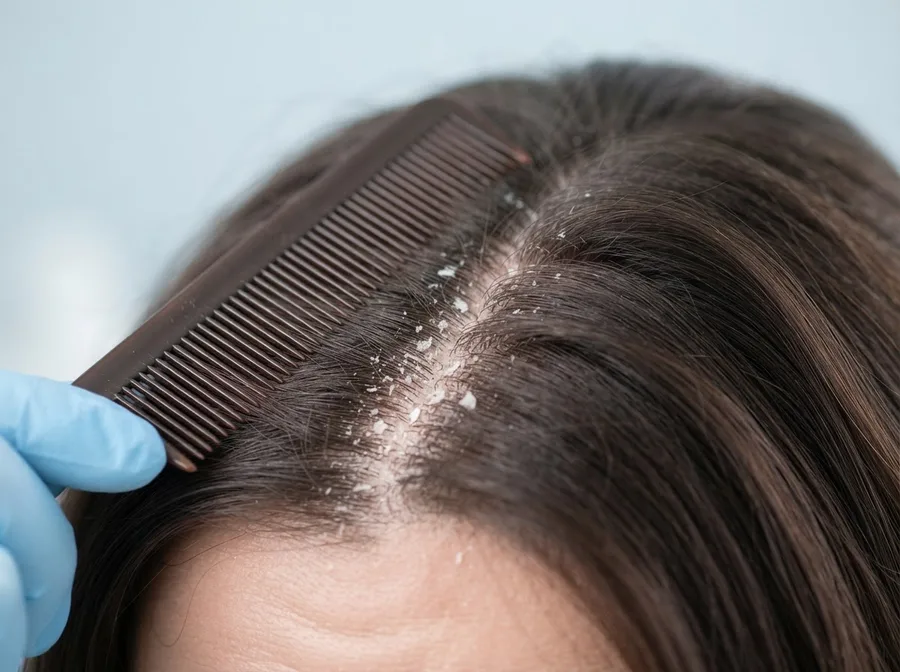
Dandruff is not dry skin. It is a reaction to a yeast called Malassezia that lives on nearly everyone's scalp. It feeds on the oil your scalp produces and leaves behind oleic acid. Some people's skin barrier does not mind this at all. If yours reacts, the scalp speeds up its shedding cycle, cells clump together with oil, and you see flakes.
That single fact changes the whole approach, and it is why the best dandruff treatment at home is antifungal rather than moisturising. Dandruff is most common on the oiliest parts of the body, which is why it shows up on the scalp, the eyebrows, the sides of the nose and the chest, and almost never on dry forearms. If dandruff were caused by dryness, it would be the other way around.
Why dandruff is worse in Bangalore
- Swinging weather: the city moves between dry spells and sudden rain. The scalp barrier is forced to adjust constantly, and flares follow the change rather than the season.
- Hard water: borewell and tanker water carries mineral deposits that leave residue on the scalp, so product sits on the skin instead of rinsing clean.
- Traffic and helmets: a long commute means hours of sweat trapped under a helmet. Warmth, occlusion and friction are ideal conditions for yeast.
- Air conditioning: a full day in a cooled office dehydrates the scalp surface and encourages compensatory oil.
- Shampoo hopping: switching anti-dandruff shampoos every fortnight means no active ingredient is ever used long enough to work.
Best dandruff treatment at home: what actually works
Most dandruff treatment in Bangalore starts exactly where you can start at home, because home treatment is genuinely effective for mild to moderate cases. The whole method rests on one thing: using a medicated shampoo with a proven active ingredient, correctly, for long enough. The shampoo is the treatment. Everything else is support.
| Active ingredient | What it does | Best suited to |
|---|---|---|
| Ketoconazole 1% to 2% | Antifungal, directly reduces Malassezia | Stubborn or recurring dandruff, the strongest over-the-counter option |
| Zinc pyrithione 1% to 2% | Antifungal and antibacterial, mild | Everyday maintenance and milder flaking |
| Selenium sulfide 2.5% | Slows cell turnover and reduces yeast | Oily scalps with heavy flaking |
| Salicylic acid | Lifts stuck scale from the scalp surface | Thick, crusted buildup, usually paired with an antifungal |
| Coal tar | Slows how fast scalp cells are shed | Long-standing dandruff, can stain light hair |
| Tea tree oil 5% | Mild antifungal with modest evidence | Mild cases, or where someone prefers a plant-based option |
Ketoconazole 1% to 2%
- What it does
- Antifungal, directly reduces Malassezia
- Best suited to
- Stubborn or recurring dandruff, the strongest over-the-counter option
Zinc pyrithione 1% to 2%
- What it does
- Antifungal and antibacterial, mild
- Best suited to
- Everyday maintenance and milder flaking
Selenium sulfide 2.5%
- What it does
- Slows cell turnover and reduces yeast
- Best suited to
- Oily scalps with heavy flaking
Salicylic acid
- What it does
- Lifts stuck scale from the scalp surface
- Best suited to
- Thick, crusted buildup, usually paired with an antifungal
Coal tar
- What it does
- Slows how fast scalp cells are shed
- Best suited to
- Long-standing dandruff, can stain light hair
Tea tree oil 5%
- What it does
- Mild antifungal with modest evidence
- Best suited to
- Mild cases, or where someone prefers a plant-based option
How to actually use an anti dandruff shampoo
- Part the hair in sections and work the anti dandruff shampoo into the scalp, not the lengths. Dandruff is a skin condition, so the medicine has to reach skin. Use fingertips, never nails.
- Leave it on for a full five minutes. This is the step nearly everyone skips, and it is the one that decides whether the treatment works.
- Rinse well, then condition the lengths only, keeping conditioner off the scalp.
- Use it two or three times a week for four weeks before judging it, then drop to once a week once it settles. Dandruff is managed rather than cured, so it returns when treatment stops.
If one active ingredient stops working after a few months, rotate to a different one rather than increasing frequency. Alternating ketoconazole with zinc pyrithione, for example, keeps the response strong over time.
Home remedies: what helps, and what quietly makes it worse
- Coconut and other hair oils: makes it worse for most people. It feeds the yeast. If you oil for length and shine, keep it off the scalp and wash it out the same day.
- Lemon juice: no useful evidence, and the acid irritates an already inflamed scalp. It can also lighten hair unevenly.
- Curd and yoghurt masks: harmless but ineffective. They soothe the sensation briefly without touching the cause.
- Apple cider vinegar: popular online, thin evidence. Diluted it rarely causes harm, but it will not clear moderate dandruff.
- Tea tree oil: genuinely has modest evidence at around 5% concentration in a shampoo. Never apply undiluted essential oil to the scalp.
- Aloe vera: can calm itching and redness. It is comfort, not treatment, and works best alongside a medicated shampoo.
- Washing less often: makes it worse. Oil and scale accumulating on the scalp is exactly what the yeast needs.
The honest summary is that the kitchen cannot out-perform an antifungal. Home remedies are reasonable as support, but the best dandruff treatment at home is still a correctly used anti dandruff shampoo. That is also where any dandruff treatment in Bangalore worth paying for begins.
When it is not dandruff at all
A good deal of what people self-treat as dandruff is a different condition wearing the same costume. These do not respond to anti-dandruff shampoo, and months of trying is months lost.
- Seborrheic dermatitis: the more inflamed end of the same spectrum. Redness, greasy yellowish scale, and involvement of the eyebrows, nose folds or ears, not just the scalp. Usually needs prescription treatment.
- Scalp psoriasis: thick, silvery, sharply bordered plaques that often extend past the hairline onto the forehead or behind the ears. It can bleed in pinpoints if the scale is picked off. See psoriasis treatment.
- Tinea capitis: a fungal infection of the hair shaft, far more common in children. Patchy hair loss, broken hairs and sometimes a boggy swelling. It needs oral antifungal medication, because shampoo cannot reach the hair shaft.
- Contact dermatitis: a reaction to a hair dye, keratin treatment or a new product. The timing gives it away: it starts within days of something new.
- Simple product buildup: dry flakes with no redness and no itch, often from dry shampoo or styling product. This clears with a clarifying wash alone.
When dandruff starts costing you hair
This is the point where a scalp treatment in Indiranagar becomes worth the visit. Dandruff does not directly kill hair follicles, but long-standing scalp inflammation does two things that cost you hair. It pushes follicles into the shedding phase earlier than they should go, and the constant scratching breaks hair mechanically at the root. Treat the inflammation and the shedding usually settles within a few months, which is why a scalp treatment in Indiranagar begins with the scalp rather than with hair products.
If density has already dropped, the scalp is settled first, then regrowth is addressed separately through PRP hair treatment or medication, depending on the cause found at the examination.
Scalp treatment in Indiranagar: what the consultation involves
At Theory of Skin, a flaky scalp is diagnosed before it is treated. Scalp treatment in Indiranagar starts with an examination, not a product. Dr. Sanjana Shivashankar, MD Dermatology, is a dermatologist in Indiranagar, Bangalore, and the visit is built around finding out which of the look-alike conditions you actually have.
- History: how long it has lasted, what you have already tried, how you wash, what products and treatments the hair has had, and whether anyone at home has the same thing.
- Scalp examination and trichoscopy: a magnified look at the scalp surface and hair shafts. Scale pattern, redness and follicle health separate dandruff from psoriasis, a fungal infection or a reaction.
- Tests where they change the answer: a fungal scraping if tinea is suspected, or blood tests if shedding points to a cause beyond the scalp, such as iron or thyroid.
- A plan you can actually follow: usually a medicated shampoo with a defined contact time and frequency, a prescription lotion or oral medication where the inflammation justifies it, and a wash routine suited to hard water.
- Review: progress is checked at around six weeks, because that is when a real change is visible rather than guessed at.
In-clinic scalp treatments exist and can help, but they work as support alongside the medical plan rather than instead of it. Anyone promising a permanent cure for dandruff in a fixed number of sessions is overselling. It is a condition that is controlled well, and kept controlled.
What scalp treatment costs in Bangalore
Most dandruff is resolved with a consultation and a medicated shampoo, which makes it one of the least expensive problems to fix properly. Cost rises only when the diagnosis turns out to be something else, when prescription medication is needed for a longer stretch, or when hair fall has to be treated alongside. The consultation fee is listed on the contact page, and anything beyond it is quoted after the scalp has been examined, not before.
Common questions
A medicated shampoo containing ketoconazole, zinc pyrithione or selenium sulfide, applied to the scalp, left on for five minutes and used two or three times a week for at least four weeks. Correct use matters more than which brand you buy.
No, and be wary of anyone who says otherwise. Malassezia lives on everyone's scalp, so dandruff is controlled rather than cured. Most people keep it away with a medicated shampoo once a week once it has settled.
Usually it makes it worse. The yeast behind dandruff feeds on oil, so overnight oiling tends to increase flaking. If you oil for the length of the hair, keep it off the scalp and wash it out the same day.
Flaking and itching usually improve within two to four weeks of correct treatment. If there is no change at all by six weeks, the diagnosis is probably not plain dandruff and it is worth seeing a dermatologist in Indiranagar.
Indirectly, yes. Ongoing inflammation and scratching push hair into the shedding phase and break hair at the root. Shedding usually settles a few months after the scalp is treated.
Dandruff flakes are larger, oilier and often yellowish, with an itchy and sometimes red scalp. Dry scalp gives small white powdery flakes with tight-feeling skin and usually dry skin elsewhere. The two need opposite routines, which is why guessing wastes months.
More often than you think. Washing two or three times a week with a medicated shampoo removes the oil and scale the yeast relies on. Washing less is one of the commonest reasons dandruff persists.
If the shampoo aisle has stopped working, the next step is finding out what you are actually treating. For dandruff treatment in Bangalore that starts with a diagnosis rather than a package, book a scalp examination. Book a scalp examination with Dr. Sanjana Shivashankar at Theory of Skin, the skin and hair clinic in Defence Colony, Indiranagar, about a ten minute walk from Indiranagar Metro. See how hair fall treatment is planned, read about the clinic, or book a consultation directly.