PRP vs hair transplant: which hair loss fix actually works?
Losing hair faster than you're losing your patience? Here is how a dermatologist decides between PRP therapy and a hair transplant, and when the answer is both.
Pollution, stress and genetics all pull in the same direction, and Bangalore supplies plenty of the first two. The good news is that hair loss has a science-backed answer that doesn't always require surgery, and knowing which answer applies to you is most of the battle.
What PRP hair treatment actually is
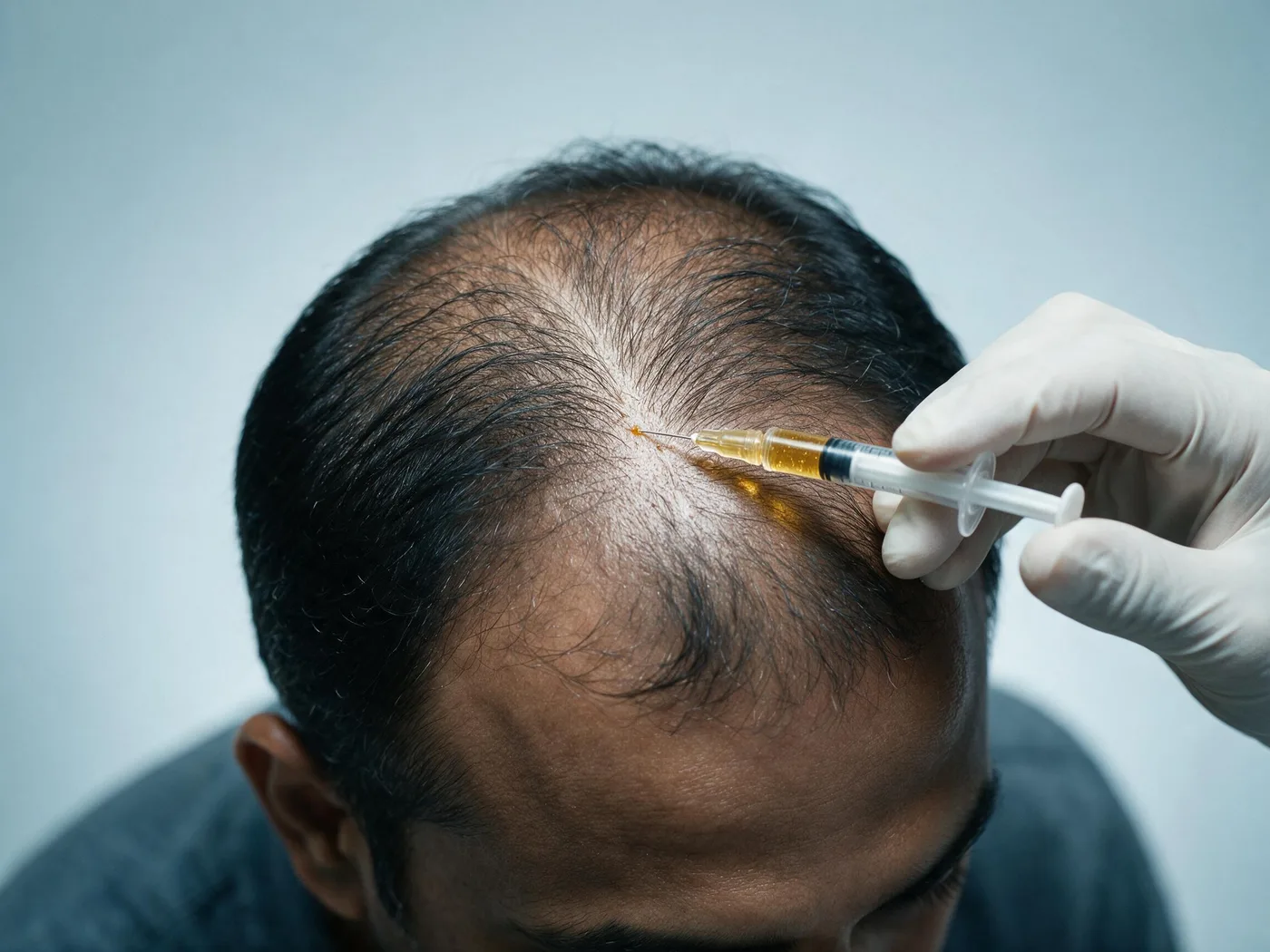
Platelet-rich plasma (PRP) therapy uses concentrated plasma from your own blood to stimulate hair growth. We draw 16 to 20ml, spin it in a centrifuge to separate the platelet-rich fraction, then inject it into the scalp at follicle level, where the growth factors reactivate dormant follicles.
- Early-stage thinning and androgenetic alopecia.
- Women with postpartum or hormonal hair loss.
- Men with receding hairlines or crown thinning.
- Anyone wanting to avoid a surgical procedure.
- Patients maintaining the results of an earlier transplant.
Results appear within three to four months after six to eight sessions spaced four weeks apart, with maintenance every three months.
Hair transplant: the surgical route
A transplant surgically relocates follicles from a donor area, usually the back of the head, to balding regions. Two techniques are in use.
- FUE (Follicular Unit Extraction): follicles extracted individually, minimal scarring (tiny dots), longer procedure, higher cost. Best for smaller areas and anyone who wears their hair short.
- FUT (Follicular Unit Transplantation): a strip of scalp is removed from the donor area, leaving a linear scar. Faster, and yields more grafts in one session, but performed less often now because of the scarring.
New growth appears at six to nine months, with full results by 12 to 18 months. The transplanted hair is permanent. Candidates are typically Norwood 3 or higher with enough donor hair and realistic expectations.
Side by side
| PRP | Hair transplant | |
|---|---|---|
| Invasiveness | Non-surgical injections | Surgical, under local anaesthetic |
| Downtime | None. Back to work the same day | 7 to 10 days |
| Pain | Mild, with topical numbing | Moderate; anaesthetic required |
| Cost | ₹6,000 to 15,000 per session | ₹50,000 to 1,50,000+ |
| Session length | 40 to 50 minutes | 4 to 8 hours |
| Ideal for | Early thinning, maintenance, prevention | Advanced baldness, permanent fill-in |
| Side effects | Redness, mild swelling for 24 to 48 hours | Infection and scarring risk |
| Durability | Maintenance every 3 to 6 months | Permanent |
Invasiveness
- PRP
- Non-surgical injections
- Hair transplant
- Surgical, under local anaesthetic
Downtime
- PRP
- None. Back to work the same day
- Hair transplant
- 7 to 10 days
Pain
- PRP
- Mild, with topical numbing
- Hair transplant
- Moderate; anaesthetic required
Cost
- PRP
- ₹6,000 to 15,000 per session
- Hair transplant
- ₹50,000 to 1,50,000+
Session length
- PRP
- 40 to 50 minutes
- Hair transplant
- 4 to 8 hours
Ideal for
- PRP
- Early thinning, maintenance, prevention
- Hair transplant
- Advanced baldness, permanent fill-in
Side effects
- PRP
- Redness, mild swelling for 24 to 48 hours
- Hair transplant
- Infection and scarring risk
Durability
- PRP
- Maintenance every 3 to 6 months
- Hair transplant
- Permanent
What Bangalore adds to the problem
Bangalore ranks among India's more polluted cities, and pollution accelerates follicle damage. Add IT-sector stress, late nights and inconsistent diet and the risks compound. PRP counteracts some of that environmental damage by delivering growth factors directly to compromised follicles. On the plus side, the city's 15 to 30°C year-round climate is genuinely good for healing after either treatment.
Cost, in detail
- PRP consultation: ₹500 to 1,000.
- PRP per session: ₹6,000 to 15,000; a four to six session package runs ₹25,000 to 75,000.
- PRP maintenance: ₹8,000 to 20,000 annually.
- Transplant consultation: ₹1,000 to 2,000.
- FUE: ₹60 to 120 per graft, with 500 to 3,000 grafts typical.
- FUT: ₹40 to 80 per graft.
PRP pricing varies with single-spin versus double-spin preparation, whether Growth Factor Concentrate is added, clinic location and doctor credentials, and the number of injection sites.
How to choose
Choose PRP if you are at Norwood 1 to 3, need zero downtime, are comfortable with multiple sessions and ongoing maintenance, want to improve scalp health and hair quality generally, or are protecting a transplant you've already had.
Choose a transplant if you have significant bald patches (Norwood 4+), want a permanent one-time solution, have adequate donor hair at the back and sides, and are ready for a surgical procedure and its recovery.
Honest expectations
PRP can reduce hair fall by 40 to 60%, increase density by 20 to 40%, improve thickness and texture, wake dormant follicles and extend the active growth phase. It cannot regrow hair on completely bald areas, because no follicle means no growth. It does not work overnight, it needs maintenance to hold, and it slows genetic hair loss rather than stopping it.
A transplant can permanently fill bald areas, build a natural hairline and restore real density for life. It cannot stop your native hair from thinning, cannot give you more hair than the donor area allows, and cannot prevent temporary shock loss in the surrounding area.
Preparation and aftercare
- Before PRP: stop blood thinners a week prior, no alcohol for 48 hours, wash hair thoroughly on the day, eat and hydrate beforehand.
- After PRP: don't wash hair for 24 hours, no strenuous exercise for 48 hours, no swimming or sauna for two to three days, and expect mild soreness at injection sites.
- Before a transplant: stop smoking two weeks prior, no alcohol for a week, stop minoxidil two weeks before, complete the prescribed lab tests and arrange transport home.
- After a transplant: sleep with your head elevated for three to five nights, don't touch the grafted area for ten days, avoid direct sun for two weeks, no gym or swimming for two to three weeks.
Common questions
Neither is better in general, because they solve different problems. PRP protects and thickens existing hair, while a transplant fills areas that are already bald. Many people use both: a hair transplant for the bald area and PRP or medication to protect the rest.
Four to six in the initial phase, spaced four weeks apart, then one session every three months for maintenance. It varies with severity and individual response.
Mild discomfort during the injections. Topical numbing cream goes on 40 minutes beforehand. Most patients find it less painful than eyebrow threading.
Not for significant baldness. PRP works on existing follicles and cannot create new ones. At Norwood 4+ with large bald patches, a transplant is the more effective option.
Shock loss at two to four weeks post-transplant is normal and temporary. The transplanted hair sheds first, then regrows permanently from month three or four.
Immediately. There is no downtime, though slight redness at injection sites may last a few hours.
Yes, but women more often have diffuse thinning rather than discrete bald patches, which makes PRP the better fit. Transplants work well for women with localised loss or traction alopecia.
Usually not. Most insurers class hair loss treatment as cosmetic.
Whichever route fits, it starts with a scalp examination and trichoscopy rather than a guess. See how PRP hair treatment and hair transplant are planned at Theory of Skin, or book a hair consultation in Indiranagar. New to the clinic? See every treatment at Theory of Skin, explained.