Dandruff treatment: what works, from shampoo to prescription.
Dandruff treatment fails most often for one of three reasons: the wrong diagnosis, the wrong ingredient, or the right shampoo used the wrong way. This guide goes through all three, step by step, the way Dr. Sanjana Shivashankar explains it in consultation at Theory of Skin, Indiranagar.
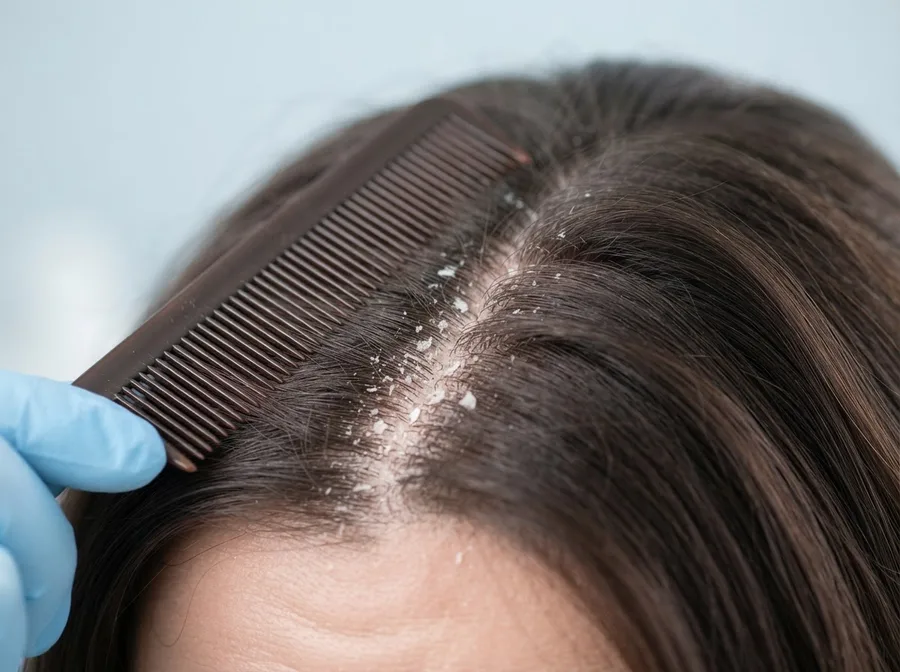
Dandruff treatment starts with knowing what kind you have
Dandruff is the mildest, non-inflamed end of a condition called seborrheic dermatitis (DermNet). It is linked to Malassezia, a yeast that lives on almost every adult's scalp and feeds on scalp oil. About half of all adults have dandruff at some point, and it is more common in men (Borda and Wikramanayake, 2015). It is not caused by poor hygiene and you cannot catch it from someone else (NHS).
Several other scalp conditions look like dandruff, and none of them respond to dandruff treatment in the same way. Matching the flakes to the right row below is the most useful thing you can do before buying anything.
| What you see | Likely cause | First step |
|---|---|---|
| Small white or yellowish flakes, mild itch, no redness | Dandruff | Medicated anti dandruff shampoo for four weeks |
| Greasy yellow scale with redness, also on eyebrows, nose folds or behind the ears | Seborrheic dermatitis | Antifungal shampoo, often with a short prescription lotion |
| Thick silvery plaques with sharp edges, past the hairline, pinpoint bleeding if picked | Scalp psoriasis | Dermatologist, because psoriasis needs its own treatment |
| Patchy flaking with broken hairs or bald spots, often in a child | Tinea capitis, a fungal infection of the hair | Dermatologist, because it needs tablets |
| Itch, redness or burning that started within days of a new dye or product | Contact dermatitis | Stop the product and see a dermatologist if it does not settle |
| Fine powdery flakes, tight scalp, dry skin elsewhere, worse in winter | Dry scalp | Gentle shampoo and less hot water, not an antifungal |
Small white or yellowish flakes, mild itch, no redness
- Likely cause
- Dandruff
- First step
- Medicated anti dandruff shampoo for four weeks
Greasy yellow scale with redness, also on eyebrows, nose folds or behind the ears
- Likely cause
- Seborrheic dermatitis
- First step
- Antifungal shampoo, often with a short prescription lotion
Thick silvery plaques with sharp edges, past the hairline, pinpoint bleeding if picked
- Likely cause
- Scalp psoriasis
- First step
- Dermatologist, because psoriasis needs its own treatment
Patchy flaking with broken hairs or bald spots, often in a child
- Likely cause
- Tinea capitis, a fungal infection of the hair
- First step
- Dermatologist, because it needs tablets
Itch, redness or burning that started within days of a new dye or product
- Likely cause
- Contact dermatitis
- First step
- Stop the product and see a dermatologist if it does not settle
Fine powdery flakes, tight scalp, dry skin elsewhere, worse in winter
- Likely cause
- Dry scalp
- First step
- Gentle shampoo and less hot water, not an antifungal
Dandruff treatment by severity
Mild: occasional flakes, little itch
- Use a zinc pyrithione or ketoconazole shampoo two or three times a week, on the scalp, left on for about five minutes.
- Keep oil off the scalp and wash it out the same day if you oil the lengths.
- Wash after sweaty days, especially after a helmet.
- Expect a clear change in two to four weeks.
Moderate: daily flakes, itch, some redness
- Use ketoconazole 2% as the main shampoo, two or three times a week for four weeks.
- If scale is thick and sticks to the scalp, add a salicylic acid or coal tar shampoo first so the antifungal can reach the skin.
- If redness spreads to the eyebrows, nose folds or ears, it is likely seborrheic dermatitis and a dermatologist can add a short prescription lotion.
Severe or keeps coming back
- See a dermatologist rather than switching shampoos again. The diagnosis may be psoriasis, a fungal infection or a reaction.
- Prescription care may include ciclopirox, a short course of an anti-inflammatory lotion, or a non-steroid cream for the face.
- Antifungal tablets are kept for widespread cases or those that do not respond to treatment on the skin (Borda and Wikramanayake, 2015).
Choosing an anti dandruff shampoo, ingredient by ingredient
| Ingredient | How it works | How to use it | Good to know |
|---|---|---|---|
| Ketoconazole 2% | Antifungal, reduces Malassezia | Twice a week for four weeks, then weekly | Strong evidence; the usual first choice for moderate dandruff |
| Ciclopirox 1% to 1.5% | Antifungal and anti-inflammatory | Two or three times a week | Good evidence; usually prescribed by a dermatologist |
| Zinc pyrithione 1% to 2% | Mild antifungal and antibacterial | Two or three times a week | Gentle enough for long-term maintenance |
| Selenium sulfide 2.5% | Slows scalp cell turnover, reduces yeast | Twice a week | Can discolour light, grey or chemically treated hair |
| Salicylic acid | Lifts stuck scale | Before or alternating with an antifungal | Does not treat the yeast on its own |
| Coal tar | Slows scalp cell turnover | Two or three times a week | Strong smell, can stain light hair |
Ketoconazole 2%
- How it works
- Antifungal, reduces Malassezia
- How to use it
- Twice a week for four weeks, then weekly
- Good to know
- Strong evidence; the usual first choice for moderate dandruff
Ciclopirox 1% to 1.5%
- How it works
- Antifungal and anti-inflammatory
- How to use it
- Two or three times a week
- Good to know
- Good evidence; usually prescribed by a dermatologist
Zinc pyrithione 1% to 2%
- How it works
- Mild antifungal and antibacterial
- How to use it
- Two or three times a week
- Good to know
- Gentle enough for long-term maintenance
Selenium sulfide 2.5%
- How it works
- Slows scalp cell turnover, reduces yeast
- How to use it
- Twice a week
- Good to know
- Can discolour light, grey or chemically treated hair
Salicylic acid
- How it works
- Lifts stuck scale
- How to use it
- Before or alternating with an antifungal
- Good to know
- Does not treat the yeast on its own
Coal tar
- How it works
- Slows scalp cell turnover
- How to use it
- Two or three times a week
- Good to know
- Strong smell, can stain light hair
“Dandruff shampoos need to be applied to and lathered on your scalp.”
The American Academy of Dermatology also advises leaving the shampoo on for about five to ten minutes, following the label, and alternating between shampoos with different active ingredients if one stops working (AAD).
The four week rule
Give one medicated shampoo four weeks of correct use before you judge it. The NHS uses the same mark: if anti dandruff shampoo has not helped after four weeks, it is time to see a doctor (NHS). Most clinical trials also measure results at four weeks. A Cochrane review found that ketoconazole and ciclopirox work better than placebo for seborrheic dermatitis, and that there is no clear evidence any one antifungal beats the others (Cochrane, 2015). In practice that means correct use matters more than finding the perfect bottle.
Dandruff treatment routines for different hair
- Straight or oily hair: wash often, even daily if the scalp gets oily, and use the medicated shampoo two or three times a week.
- Curly, coily or coarse hair: wash as needed and use the medicated shampoo about once a week, on the scalp only, then condition the lengths. The AAD gives the same advice.
- Coloured or chemically treated hair: keep the medicated shampoo on the scalp, choose ketoconazole or zinc pyrithione over selenium sulfide, and wait a few days after colouring.
- Long hair and regular oiling: oil the lengths only, never the scalp, and wash it out the same day.
- Beard dandruff: the same yeast causes it. Use the medicated shampoo on the beard twice a week, left on for a few minutes.
- Long helmet commutes: wear a thin cotton liner, wash the liner often, and rinse the scalp after long rides.
Dandruff outside the scalp
The same yeast lives wherever skin is oily, so flaking can also appear on the eyebrows, the sides of the nose, behind the ears, in the beard and on the upper chest. That pattern usually means seborrheic dermatitis rather than simple dandruff, and the skin of the face needs gentler treatment than the scalp. Thick yellow scale on a baby's scalp, cradle cap, is common and usually harmless, but a baby should be seen by a doctor before any medicated product is used.
What a dermatologist adds to dandruff treatment
- A diagnosis: a scalp examination and trichoscopy separate dandruff from psoriasis, fungal infection and reactions, so you stop treating the wrong thing.
- Stronger treatment when needed: prescription antifungals, a short course of an anti-inflammatory scalp lotion for itch and redness, or a non-steroid cream for the face.
- Tests that change the plan: a fungal scraping when tinea is possible, or blood tests when hair fall suggests a cause beyond the scalp.
- A plan you can follow: the exact shampoo, contact time, frequency and maintenance routine, and a review at four to six weeks.
At Theory of Skin, this is how dandruff treatment in Bangalore is planned. The visit starts with the scalp, not a package, and most people leave with a home plan rather than a course of sessions.
Keeping dandruff away
- Once flaking settles, keep the medicated shampoo once a week. DermNet notes that adults often need long-term maintenance.
- Rotate between two active ingredients every few months if one seems to stop working.
- Wash after heavy sweating, gym sessions and long helmet rides.
- Keep oil, heavy creams and dry shampoo off the scalp.
- Restart the full routine at the first sign of a flare, often with a change of season or a stressful few weeks.
Dandruff treatment myths
- Dandruff means you are not washing enough: not true. It is linked to a yeast and to how your skin reacts to it, not hygiene, though washing less can make it more visible.
- Dandruff is contagious: not true. You cannot catch dandruff.
- Oiling cures dandruff: usually the opposite. The yeast feeds on oil.
- A stronger shampoo every day works faster: correct contact time and steady use matter more than strength, and daily strong products can irritate the scalp.
- Dandruff can be cured permanently: it is controlled rather than cured. Be wary of any permanent cure promise.
Common questions
A ketoconazole 2% shampoo applied to the scalp, left on for about five minutes, two or three times a week. Itching usually eases within one to two weeks and flaking within two to four.
Choose by ingredient, not brand: ketoconazole for moderate dandruff, zinc pyrithione for mild dandruff and maintenance, selenium sulfide for oily scalps, and salicylic acid or coal tar for thick scale.
Two or three times a week for the first four weeks, then once a week to keep it away. People with curly or coily hair may do better with once a week from the start.
Not exactly. It is a reaction to Malassezia, a yeast that normally lives on the scalp. That is why antifungal shampoos work. A true fungal infection of the hair, tinea capitis, is a different condition that needs tablets.
Indirectly. Months of scalp inflammation and scratching increase shedding. Hair usually recovers after the scalp is treated. See hair fall treatment if thinning continues.
Yes, if four weeks of correct medicated shampoo use has not helped, or if there is redness, bleeding, flaking on the face or hair fall. A dermatologist can confirm the diagnosis and prescribe stronger treatment.
At Theory of Skin, Defence Colony, Indiranagar, a 10 minute walk from Indiranagar Metro. Dr. Sanjana Shivashankar, MD Dermatology, examines the scalp before any treatment. See dandruff treatment.
Sources
- American Academy of Dermatology: How to treat dandruff
- NHS: Dandruff
- DermNet: Seborrhoeic dermatitis
- Cochrane: Topical antifungals for seborrhoeic dermatitis (Okokon and others, 2015)
- Borda and Wikramanayake: Seborrheic dermatitis and dandruff, a comprehensive review (2015)
For a home routine, read dandruff treatment at home. When home care is not enough, see how dandruff treatment in Bangalore is planned at Theory of Skin, how hair fall treatment works, or book a hair consultation with Dr. Sanjana Shivashankar in Indiranagar.
This guide is written by the Theory of Skin team around how Dr. Sanjana Shivashankar, MBBS, MD Dermatology, FRGUHS (Dermatosurgery), explains dandruff treatment in consultation. Last updated 18 October 2026.