Hair fall treatment: causes, tests and what actually works.
Hair fall treatment works when it matches the cause. Shedding after a fever, genetic thinning, low iron, a thyroid problem and a scalp condition can all look the same in the shower drain, and each needs a different plan. This guide goes through them the way Dr. Sanjana Shivashankar explains hair fall in consultation at Theory of Skin, Indiranagar.
How much hair fall is normal?
Every hair grows for several years, rests for a few months and then falls out as a new hair pushes up behind it. That is why some hair fall every day is healthy. You notice it most on wash days, after oiling and when hair is long, because loose hairs collect in one place instead of falling through the day.
“It's normal to shed between 50 and 100 hairs a day.”
Hair fall is worth investigating when it stays above that for more than a few weeks, or when you can see more scalp than before (AAD). These are the signs to take seriously:
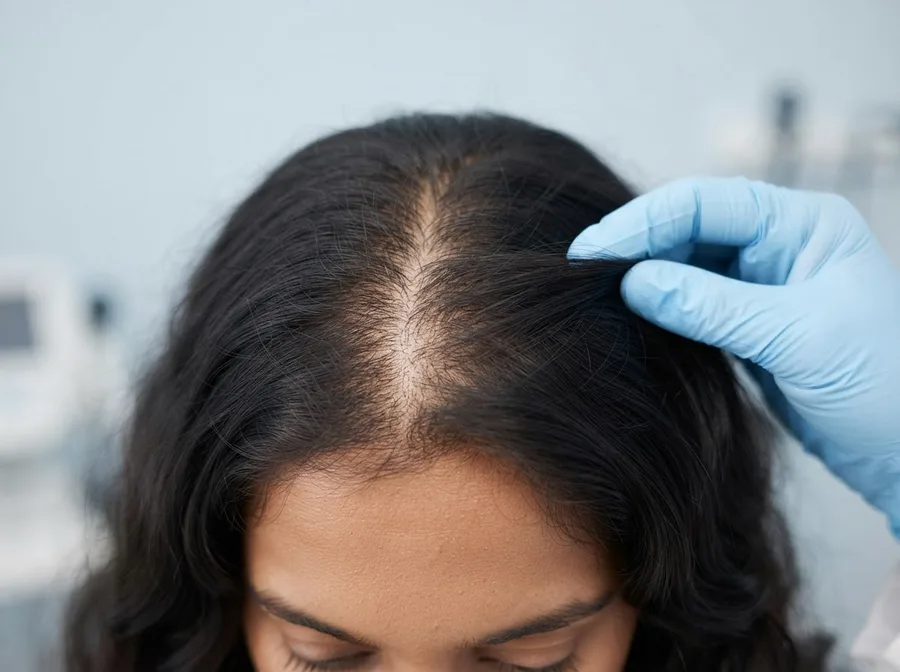
- A parting that is getting wider, or more scalp showing under bright light.
- A receding hairline at the temples, or thinning at the crown.
- A ponytail that feels noticeably thinner than a year ago.
- Round, smooth bald patches on the scalp, beard or eyebrows.
- Short broken hairs rather than full hairs with a root.
- Itching, redness, scaling or pain on the scalp.
- Hair fall together with tiredness, weight change, irregular periods, or after starting a new medicine.
Hair fall or hair loss? Shedding and thinning are different
Hair fall is the hair you see coming out. Hair loss is what is left behind on the scalp. The two often happen together, but the cause decides the hair fall treatment, so matching what you notice to the right row below is the most useful first step.
| What you notice | Likely cause | What usually helps |
|---|---|---|
| Handfuls of hair in the drain and on the pillow, two to four months after a fever, dengue, typhoid, surgery, crash dieting, childbirth or a stressful event | Telogen effluvium (shedding) | Find and fix the trigger. Usually recovers on its own; iron and thyroid are checked |
| Parting slowly getting wider, crown thinning, ponytail thinner (women) | Female pattern hair loss | Minoxidil, treatment of any hormonal cause, PRP as an add-on |
| Receding temples or a thinning crown (men) | Male pattern hair loss | Minoxidil, finasteride if suitable, PRP as an add-on, a hair transplant for stable areas |
| Round, smooth bald patches, sometimes in the beard or eyebrows | Alopecia areata | Dermatologist: injections or creams into the patches |
| Short broken hairs and rough ends after colouring, straightening or tight hairstyles | Breakage or traction | Stop the trigger and change how the hair is styled |
| Flaking, itching, redness or scaling with the hair fall | A scalp condition such as dandruff, seborrheic dermatitis or psoriasis | Treat the scalp first. See dandruff treatment |
| Patchy loss with scaling or broken hairs in a child | Tinea capitis, a fungal infection of the hair | Dermatologist, because it needs tablets |
Handfuls of hair in the drain and on the pillow, two to four months after a fever, dengue, typhoid, surgery, crash dieting, childbirth or a stressful event
- Likely cause
- Telogen effluvium (shedding)
- What usually helps
- Find and fix the trigger. Usually recovers on its own; iron and thyroid are checked
Parting slowly getting wider, crown thinning, ponytail thinner (women)
- Likely cause
- Female pattern hair loss
- What usually helps
- Minoxidil, treatment of any hormonal cause, PRP as an add-on
Receding temples or a thinning crown (men)
- Likely cause
- Male pattern hair loss
- What usually helps
- Minoxidil, finasteride if suitable, PRP as an add-on, a hair transplant for stable areas
Round, smooth bald patches, sometimes in the beard or eyebrows
- Likely cause
- Alopecia areata
- What usually helps
- Dermatologist: injections or creams into the patches
Short broken hairs and rough ends after colouring, straightening or tight hairstyles
- Likely cause
- Breakage or traction
- What usually helps
- Stop the trigger and change how the hair is styled
Flaking, itching, redness or scaling with the hair fall
- Likely cause
- A scalp condition such as dandruff, seborrheic dermatitis or psoriasis
- What usually helps
- Treat the scalp first. See dandruff treatment
Patchy loss with scaling or broken hairs in a child
- Likely cause
- Tinea capitis, a fungal infection of the hair
- What usually helps
- Dermatologist, because it needs tablets
Hair fall causes in women
- After childbirth: shedding often starts about two months after delivery and peaks around four months. Within six to nine months the hair usually regains its normal fullness (AAD).
- Low iron: heavy periods and pregnancy are the most common causes of iron deficiency in women before menopause. A ferritin test shows the body's iron stores (Trost and others, 2006).
- Thyroid problems: both an underactive and an overactive thyroid can cause diffuse hair fall, which usually improves once thyroid levels are treated.
- PCOS and hormonal changes: can show as thinning at the crown or parting, often with irregular periods, acne or facial hair.
- Female pattern hair loss: runs in families and shows as a gradually widening parting while the front hairline stays in place (DermNet).
- Crash diets and low protein: sudden weight loss or very low protein intake can trigger shedding a few months later.
- Styling: tight buns and braids, frequent heat, and chemical straightening or smoothening can break hair or pull it out at the hairline.
Hair fall causes in men
- Male pattern hair loss: the most common cause. It runs in families and starts at the temples, the crown or both (NHS).
- Shedding after illness or stress: the same telogen effluvium seen in women, usually two to four months after a fever, surgery or a hard few weeks.
- Dandruff and seborrheic dermatitis: long-standing scalp inflammation and scratching increase shedding. Read the dandruff treatment guide.
- Alopecia areata: round bald patches on the scalp or in the beard.
- Medicines and supplements: some medicines, and anabolic steroids used for bodybuilding, can trigger or speed up hair fall. Tell the doctor about everything you take.
Stress, nutrition and hormones: three things to check first
In the reel below, Dr. Sanjana Shivashankar explains why hair works as a marker of what is happening inside the body. Most hair fall that is not genetic traces back to one of three things, which is why a consultation asks about your last few months before it looks at your scalp.
- Stress: a shock to the body, from a high fever to a difficult period at work, can push many hairs into the resting phase at once. They fall two to four months later, which is why people rarely connect the two (DermNet).
- Nutrition: hair follicles are among the fastest growing tissues in the body, so low iron, low protein or a crash diet often shows in the hair first.
- Hormones: thyroid problems, PCOS, pregnancy and stopping the contraceptive pill can all change how much hair grows and how much falls.
Which vitamin deficiency causes hair fall? The blood tests that matter
Blood tests are chosen after the scalp is examined. Not everyone needs all of them, and a normal scalp examination with a clear trigger, such as a recent fever, may need none.
| Test | Why it is checked |
|---|---|
| Complete blood count (haemoglobin) | Screens for anaemia |
| Serum ferritin | Shows iron stores. Low ferritin is common in women with heavy periods and in vegetarian diets |
| TSH (thyroid) | An underactive or overactive thyroid can cause diffuse hair fall |
| Vitamin D | Low levels are common and are often checked alongside other causes |
| Vitamin B12 | More likely to be low on a vegetarian diet |
| Hormone tests | When there are signs of PCOS, such as irregular periods, acne or facial hair |
Complete blood count (haemoglobin)
- Why it is checked
- Screens for anaemia
Serum ferritin
- Why it is checked
- Shows iron stores. Low ferritin is common in women with heavy periods and in vegetarian diets
TSH (thyroid)
- Why it is checked
- An underactive or overactive thyroid can cause diffuse hair fall
Vitamin D
- Why it is checked
- Low levels are common and are often checked alongside other causes
Vitamin B12
- Why it is checked
- More likely to be low on a vegetarian diet
Hormone tests
- Why it is checked
- When there are signs of PCOS, such as irregular periods, acne or facial hair
Hair fall treatment options, explained honestly
| Treatment | What it does | Suited to | When you see a change |
|---|---|---|---|
| Treating the cause | Corrects low iron, thyroid problems, scalp inflammation or a trigger | Shedding (telogen effluvium) and scalp conditions | Shedding slows over two to three months; fullness returns over six to nine |
| Minoxidil lotion or foam | Keeps follicles in the growth phase longer and thickens fine hairs | Pattern hair loss in women and men | Three to six months; judged at six |
| Low-dose oral minoxidil | The same effect, taken as a tablet | People who cannot use the lotion; prescription only | Three to six months |
| Finasteride | Lowers the hormone that shrinks follicles in pattern hair loss | Men with pattern hair loss; prescription only | Several months |
| PRP hair treatment | Platelets from your own blood injected into the thinning areas | Early pattern thinning, alongside minoxidil | Three to six months |
| GFC therapy | A growth factor concentrate prepared from your blood, similar to PRP | Similar to PRP; fewer studies so far | Similar to PRP |
| FUE hair transplant | Moves follicles from the back of the head to thinning areas | Stable pattern hair loss with enough donor hair | Most of the result shows between six and twelve months |
Treating the cause
- What it does
- Corrects low iron, thyroid problems, scalp inflammation or a trigger
- Suited to
- Shedding (telogen effluvium) and scalp conditions
- When you see a change
- Shedding slows over two to three months; fullness returns over six to nine
Minoxidil lotion or foam
- What it does
- Keeps follicles in the growth phase longer and thickens fine hairs
- Suited to
- Pattern hair loss in women and men
- When you see a change
- Three to six months; judged at six
Low-dose oral minoxidil
- What it does
- The same effect, taken as a tablet
- Suited to
- People who cannot use the lotion; prescription only
- When you see a change
- Three to six months
Finasteride
- What it does
- Lowers the hormone that shrinks follicles in pattern hair loss
- Suited to
- Men with pattern hair loss; prescription only
- When you see a change
- Several months
- What it does
- Platelets from your own blood injected into the thinning areas
- Suited to
- Early pattern thinning, alongside minoxidil
- When you see a change
- Three to six months
GFC therapy
- What it does
- A growth factor concentrate prepared from your blood, similar to PRP
- Suited to
- Similar to PRP; fewer studies so far
- When you see a change
- Similar to PRP
- What it does
- Moves follicles from the back of the head to thinning areas
- Suited to
- Stable pattern hair loss with enough donor hair
- When you see a change
- Most of the result shows between six and twelve months
Minoxidil for hair fall: what to expect
Minoxidil is the most studied hair fall treatment for pattern hair loss in both women and men. A Cochrane review found that it works better than placebo in women, and that the 5% strength was not clearly better than 2% (Cochrane, 2016). Finasteride and minoxidil are the main treatments for male pattern hair loss (NHS).
- Apply it to a dry scalp, not the hair, at the dose and frequency prescribed.
- Expect extra shedding in the first few weeks. It usually means weak hairs are being replaced and settles on its own.
- Look for the first change at around three to four months, and judge the result at six.
- Keep using it. The hair it holds on to is usually lost again within a few months of stopping.
- Tell the doctor about itching or redness, or unwanted facial hair, which can happen in women.
For people who find the lotion difficult to use every day, low-dose oral minoxidil has been reviewed as an effective and well tolerated alternative in healthy patients (Randolph and Tosti, 2021). It is a prescription medicine and is only started after a doctor checks that it is safe for you.
PRP treatment for hair fall: who it helps
PRP, platelet-rich plasma, uses a small sample of your own blood. The platelets are concentrated and injected into the thinning areas of the scalp, usually in three to four sessions about a month apart, followed by maintenance sessions every few months. It suits early pattern thinning, where follicles are still alive but producing finer hair. It does not regrow hair on completely bald skin, and it adds little to shedding that will recover on its own.
The evidence supports PRP as a partner to minoxidil rather than a replacement. A 2023 network meta-analysis of 27 trials and 1,110 patients ranked minoxidil with PRP above minoxidil alone, and PRP alone below minoxidil alone (Gupta and others, 2023). See how PRP hair treatment is planned at the clinic, or compare PRP and a hair transplant.
Hair fall after delivery, fever or dengue
Shedding that starts a few months after childbirth, dengue, typhoid, a viral fever or surgery is usually telogen effluvium. The body pushed many hairs into the resting phase during the illness, and they fall together two to four months later (DermNet; Malkud, 2015). The hair normally grows back once the trigger has passed. See a dermatologist if it continues beyond six months, if the parting or crown looks thinner rather than just shedding, or if you feel unwell, because shedding can uncover pattern hair loss that was already starting.
How to stop hair fall: what you can do at home
No home remedy stops hair fall immediately, and anything that promises to is worth avoiding. These steps do help the hair fall treatment you are on, and some prevent hair fall from getting worse:
- Eat enough protein and iron: dal, eggs, paneer, fish, soya, leafy greens and millets. Avoid crash diets.
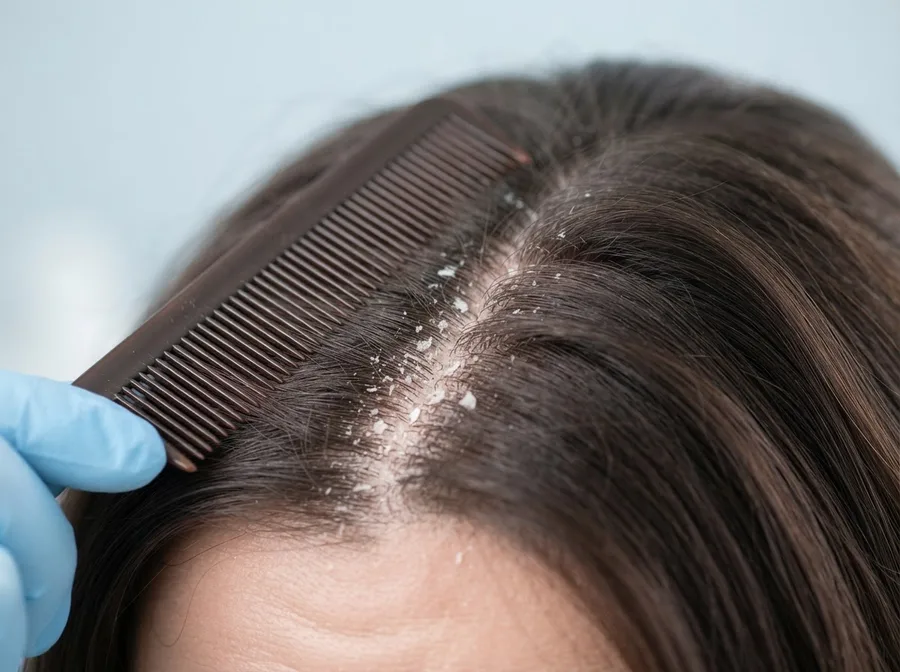
- Treat dandruff: an inflamed scalp sheds more. A medicated shampoo used correctly is often enough. See dandruff treatment at home.
- Wash as often as you need: washing does not cause hair loss. The hairs you see on wash day were already loose.
- Oil the lengths, not the scalp: oil softens the hair shaft but does not grow hair, and on a dandruff-prone scalp it feeds the yeast.
- Go easy on styling: loosen tight buns and braids, and space out heat and chemical treatments.
- Sleep and manage stress: the effect shows in the hair a few months later, not the next week.
- Hard water: there is little evidence that hard water makes hair fall from the root, though it can leave hair rough and easier to break.
Dermatologist or trichologist: who should treat hair fall?
A dermatologist. Hair and scalp disorders are part of dermatology, and a dermatologist can examine the scalp, diagnose conditions such as alopecia areata or scalp psoriasis, order blood tests and prescribe medicines like minoxidil or finasteride. Trichology courses are not a medical degree, so check that the person treating you is a qualified dermatologist, with an MD or DNB in Dermatology, before you start a prescription treatment or a procedure. A hair specialist in Bangalore should be able to explain the cause before suggesting a package.
Hair fall treatment in Bangalore at Theory of Skin
- Your history: recent illness, diet, periods, pregnancy, medicines, supplements and family history.
- Scalp examination and trichoscopy: a magnified look at the scalp and hair shafts that separates shedding, pattern thinning, alopecia areata, breakage and scalp disease.
- Tests, only if needed: the blood tests your history and scalp point to.
- A plan matched to the cause: a home routine, prescription treatment, and PRP, GFC or a hair transplant only if they suit you.
- Review at about three months: to check the response and adjust the plan.
This is how hair fall treatment in Bangalore is planned at Theory of Skin, 578, 9th A Main Rd, Defence Colony, Indiranagar, a 10 minute walk from Indiranagar Metro. Dr. Sanjana Shivashankar, MBBS, MD Dermatology, FRGUHS (Dermatosurgery), examines the scalp before any treatment is suggested.
Common questions
The one matched to the cause. Shedding after illness or stress needs the trigger fixed and time. Low iron or thyroid problems need those treated. Pattern hair loss responds to minoxidil, with PRP or finasteride added when suitable. A scalp examination tells you which one you have.
Nothing stops hair fall overnight. Hair that is already shedding was pushed into the resting phase weeks or months earlier. What you can do now is find the cause, treat any dandruff, eat enough protein and iron, and avoid harsh styling. Treatment usually slows hair fall within two to three months.
Low iron stores, measured as ferritin, are the most common nutritional cause, especially in women. Low vitamin D and vitamin B12 are also checked. Test before taking supplements, because extra iron can do harm.
Shedding from stress, illness, childbirth or low iron usually recovers within six to nine months once the cause is fixed. Pattern hair loss can be slowed and partly reversed with treatment. Follicles that are completely gone do not regrow without a hair transplant.
Yes. A stressful event, high fever or surgery can push many hairs into the resting phase at once, and they fall about two to four months later. It usually settles on its own.
It slows pattern hair loss and can thicken thinning hair. It works over months, often after a short phase of extra shedding, and the benefit is usually lost within a few months of stopping.
PRP helps early pattern thinning, and works better alongside minoxidil than on its own. It does not regrow hair on bald skin. See PRP hair treatment.
It depends on the cause: iron and thyroid treatment, management of PCOS, time for shedding after childbirth, and minoxidil for female pattern hair loss. Finasteride is not used in women who could become pregnant.
Shedding usually slows within two to three months of the right treatment. Visible regrowth takes three to six months, and fullness can take six to twelve, because hair grows about a centimetre a month.
At Theory of Skin, Indiranagar, a hair consultation is ₹849 and starts with a scalp examination. Treatment cost depends on the cause, from medication alone to PRP hair treatment or a hair transplant, and is quoted after the assessment.
At Theory of Skin, 578, 9th A Main Rd, Defence Colony, Indiranagar, a 10 minute walk from Indiranagar Metro. Dr. Sanjana Shivashankar, MD Dermatology, examines the scalp before any treatment. See hair fall treatment in Bangalore.
Sources
- American Academy of Dermatology: Do you have hair loss or hair shedding?
- American Academy of Dermatology: Hair loss, diagnosis and treatment
- American Academy of Dermatology: Hair loss, tips for managing
- NHS: Hair loss
- DermNet: Telogen effluvium
- DermNet: Female pattern hair loss
- DermNet: Male pattern hair loss
- Cochrane: Treatments for female pattern hair loss (van Zuuren and others, 2016)
- Trost, Bergfeld and Calogeras: Iron deficiency and its potential relationship to hair loss (2006)
- Randolph and Tosti: Oral minoxidil treatment for hair loss, a review of efficacy and safety (2021)
- Gupta and others: Minoxidil 5%, platelet-rich plasma and microneedling in pattern hair loss, a network meta-analysis (2023)
- Malkud: Telogen effluvium, a review (2015)
When flaking comes with the hair fall, read the dandruff treatment guide. When home care is not enough, see how hair fall treatment in Bangalore is planned at Theory of Skin, how PRP hair treatment works, or book a hair consultation with Dr. Sanjana Shivashankar in Indiranagar.
This guide is written by the Theory of Skin team around how Dr. Sanjana Shivashankar, MBBS, MD Dermatology, FRGUHS (Dermatosurgery), explains hair fall treatment in consultation. Last updated 23 October 2026.